Career spotlight: ENVS alum Viraj Sikand ’17 is creating new financial incentives for conservation
Through his Kenya-based startup EarthAcre, Sikand is building digital tools that help communities get paid for protecting nature. He shares the inspiration behind his business, how his Brown education influenced his path, and advice for students exploring environmental careers.
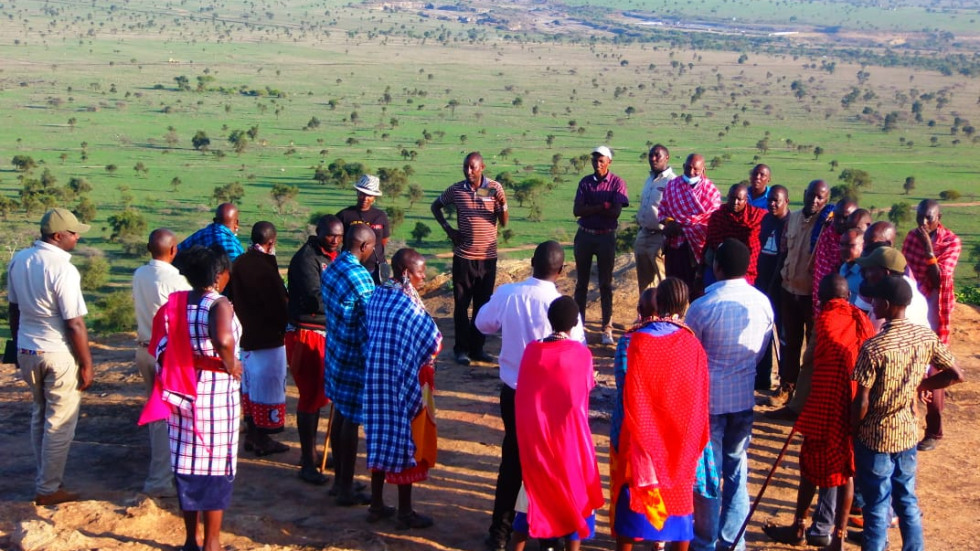
Through his Kenya-based company EarthAcre, Brown alum Viraj Sikand ’17 works with community landowners to create financial incentives for protecting wildlife and natural landscapes, helping make conservation economically sustainable for local communities.
Positive environmental practices don’t pay the bills for the average community member living in and among nature, says Viraj Sikand ’17. His company, EarthAcre, aims to change that, starting in Kenya. There is money for nature, he explains, but little of it reaches the people protecting it.

Tourism operators, for example, pay to use community land, while companies purchase carbon credits. Yet less than one percent of that money makes its way to local communities.
Without a financial incentive to protect their land and wildlife, community members may conclude, “I’ve not been earning anything from this,” Sikand says. “I’m going to shoot the elephant. I’m going to sell my land.” They aren’t selling to buy luxuries, he adds: “It’s actually like, ‘I need to literally pay for school fees for my kids. ” Or as he told the Guardian in 2025, “Unless such payments are delivered directly to landowners, all the land will go.”
The thinking behind EarthAcre started to take root at Brown, when Institute at Brown for Environment and Society professor Dov Sax encouraged Sikand to apply to the Doris Duke Conservation Scholars Program, which brought him to the Quinault Indian Nation in Washington State each summer.
Sikand saw connections between the positive environmental impact of the Quinault’s traditional practices and values and that of communities in his native Kenya, where EarthAcre is based: “a lot of Indigenous communities are pastoralist, so they move their cattle over very large areas,” he says. “That leaves the land open for macro fauna, for wildlife.”
Money for protecting the land
EarthAcre builds digital tools for community management, payouts, and nature monitoring. Every community member goes through training on the project, so “they know their rights,” Sikand says. EarthAcre then records consent, land ownership, and beneficiary details. At one tourism camp, where hundreds of thousands of dollars per year were going to a few individuals, the money now goes to more than 3,000.
“ When people benefit directly, trees remain on the land. The elephant is no longer a pest. ”
Today, Sikand says, EarthAcre has “over 5,000 people on our tools” and “over 130,000 acres being protected or restored for nature.” The company was also piloting a program by Verra, a leading organization in certifying carbon credits, that seeks to give companies a way to pay for protecting nature, not just for storing carbon, according to that same press release. Sikand says EarthAcre is also at the forefront of efforts in Kenya to require projects that damage nature to pay to protect an area of ecological equivalence. EarthAcre is currently negotiating contracts which would bring 35,000 people into financial inclusion over the next six months.
“Remember,” Sikand says, “these are oftentimes the first payments, certainly from nature, that most people have ever received.”
Probably the biggest learning was, I needed to learn more. Building a business is super hard, building an environmental business, even harder.

Lessons from his career
Nine lessons learned along the way, for students and aspiring environmental entrepreneurs
Growing up, Sikand spent most weekends on open community land in Kitengela, where his parents work with an NGO called The Wildlife Foundation. It borders Nairobi National Park, which is fenced on only three sides. It’s “the only place in the world you can see lions and rhinos [roaming free] in the heart of a capital city,” he says—animals wander into the community land at will. His family, going back to his grandparents, “have done a lot of work at the intersection of environment and communities,” he says.
Below, Sikand talks about how got from those weekends in Kitengela to his environmental studies concentration at Brown to founding EarthAcre and shares what he learned along the way. Again and again, he drew on connections he made through Brown and IBES. Sikand also met his wife, Abbey Perreault ’16, at Brown, which leaves him, he says, “deeply grateful in more ways than one to the university.”