Institute at Brown for Environment and Society

IBES at COP30: Faculty examine wins, setbacks, and what comes next

Through on-the-ground interviews and new insights on misinformation, IBES faculty members Myles Lennon and Timmons Roberts uncovered what COP30 achieved—and what still stands in the way.

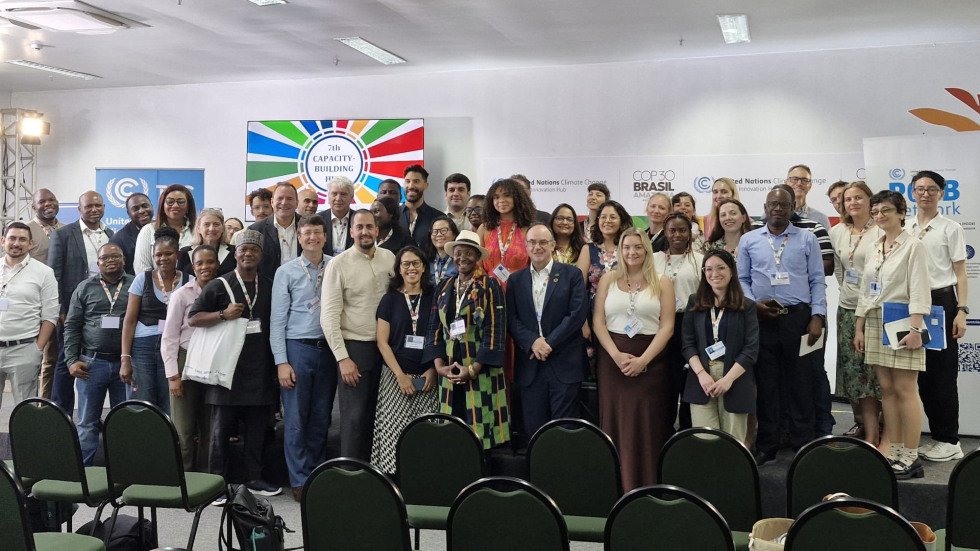
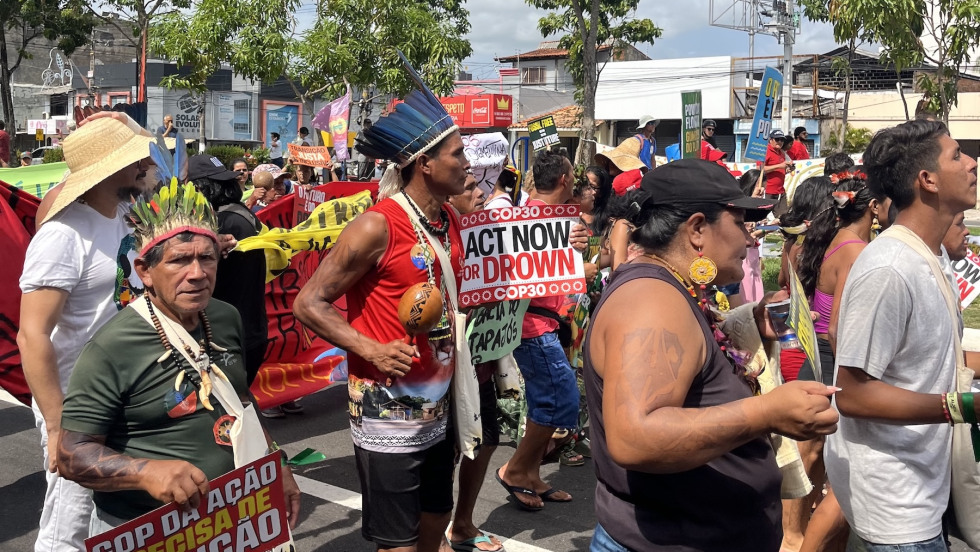
Last month, Brown faculty, students, and research partners joined thousands of delegates, organizers, and community leaders at the 30th UN Climate Change Conference (COP30), where global negotiations centered on reviewing progress since the 2015 Paris agreement, just transitions, and whether a roadmap could be drafted for a global transition off fossil fuels in the second-largest ever of the UN climate conferences. Brown’s presence, anchored by Myles Lennon, Dean’s Associate Professor of Environment and Society and Anthropology, and Timmons Roberts, Ittleson Professor of Environmental Studies and Sociology, showcased the University’s continuing engagement in international climate governance.

Hosted in Belém, Brazil, COP30 offered a rare opportunity to situate global climate policymaking within one of the world’s most ecologically and culturally significant landscapes. Lennon and Roberts participated in a series of high-level conversations throughout the week.
Taking aim at climate misinformation

A central focus of Roberts’s work in Belém was the growing threat of climate misinformation and disinformation — an issue that scientists, civil society coalitions, and policy makers elevated more forcefully at COP30 than ever before. 

Roberts, who serves as Executive Director of the IBES-based Climate Social Science Network (CSSN), emphasized how climate disinformation undermines democratic processes, weakens public health protections, and slows progress toward emissions reductions. “Disinformation is everywhere. It’s sophisticated. It’s evolving rapidly,” he said. “The fossil-fuel industry spends about 10 times more on lobbying than environmental and renewable sectors combined. They spend about 19 times more on public relations, and they do this to maintain their social license to operate.”

He further noted that addressing disinformation requires understanding the “tactics, key actors, and flow of power, money and information” behind obstruction efforts. It also requires “appealing to conservative identities, to the identities of the people you’re speaking to, and using debunking and pre-bunking strategies,” he urged. 

This year, the global community responded. Twenty-one countries, including Brazil, Canada, France, Germany, Spain, and the United Kingdom, signed a declaration committing to protecting information integrity and combating climate misinformation.

“ For too long there has been a ‘denial of the denial’ at the climate talks. We’re not going to solve climate change unless we understand the forces that are arraying to stop climate action. [The Global Initiative for Information Integrity on Climate Change] is an important step to getting there. ”

Professor Timmons Roberts

Launching global research on climate obstruction

COP30 also served as the global launch of Climate Obstruction: a Global Assessment, a major new volume from the CSSN, co-authored by international 110 researchers. Roberts participated in two press conferences and four panels, including book launch events at the Federal University of Pará and at the Casa da Cidade of the Interdisciplinary Observatory on Climate Change. 

The assessment arrived amid increasing scrutiny of lobbyists and public relations firms operating within United Nations Framework Convention on Climate Change (UNFCCC) spaces. Roughly one in every 25 COP30 attendees represented fossil-fuel interests, and Edelman—a major PR firm serving fossil-fuel companies—managed official communications for the COP30 hosts. 

Climate convenings through an anthropological lens

Associate Professor Myles Lennon broadened the frame, assessing how effectively COP30 operated beyond its formal aims. If these conferences are essentially about reaching multilateral climate agreements, Lennon noted, then COP30 was a failure “but COP is about so much more than these things,” he said.

“ We need to forthrightly address how COP succeeds and what it does outside the scope of a global agreement if we wish to understand why this thing that has not led to the results that many of us hope for keeps happening. ”

Associate Professor Myles Lennon

Driven by two primary research questions (what does COP succeed at, and for whom does it succeed?) Lennon conducted nearly 50 interviews with COP stakeholders, from UNFCCC Secretariat representatives and solar entrepreneurs in sub-Saharan Africa to party delegates from Western Europe, Central American Indigenous activists, and local residents of Belém.

Lennon ultimately determined six key areas in which COP30 succeeded: 

  • serving as a social ritual — a win for like-minded climate professionals, whose work can often prove alienating
  • generating funding and investment for climate resiliency in the Global South (including regenerative Indigenous climate adaptation projects that are already underway in Belize) — a win for Indigenous activists
  • bolstering local pride — a win for Belém residents as they hosted a major international event and gained global recognition
  • creating demand for climate-related businesses and products, such as nuclear energy — a win for entrepreneurs and industry
  • promoting tourism in Brazil — a win for local government

“All of these things have their downsides too,” Lennon said, citing the prioritization of water infrastructure for COP participants over perpetually flooded communities in Belém. But “the point here,” he said, “is that COP is complicated and doesn’t fit into neat narratives of success or failure — and that it is about so much more than a multilateral agreement!”

What comes next

COP30 underscored the urgency of bolder, more inclusive climate action, and the need for research institutions to play a generative role in shaping that future. IBES will continue building on the relationships, conversations, and commitments sparked in Belém as faculty, students, and partners work toward a more equitable climate trajectory.

More coverage