Hundreds of students and community members came together across campus for Climate Week 2026, transforming lecture halls and auditoriums into forums for exchange. Over the course of several days, conversations moved fluidly between theory and practice, from student career aspirations to the mechanics of sustainable finance, and from the moral imperatives of environmental justice to decarbonization strategies.
Institute at Brown for Environment and Society
Date
March 22, 2026
Brown’s first Climate Week, led by IBES, sparks campus-wide climate conversations
What does it take to confront the climate crisis, and where do we all fit in? This March, Brown students, faculty, staff, and community members came together across the campus to explore a wide range of answers.
Forging Climate Career Pathways
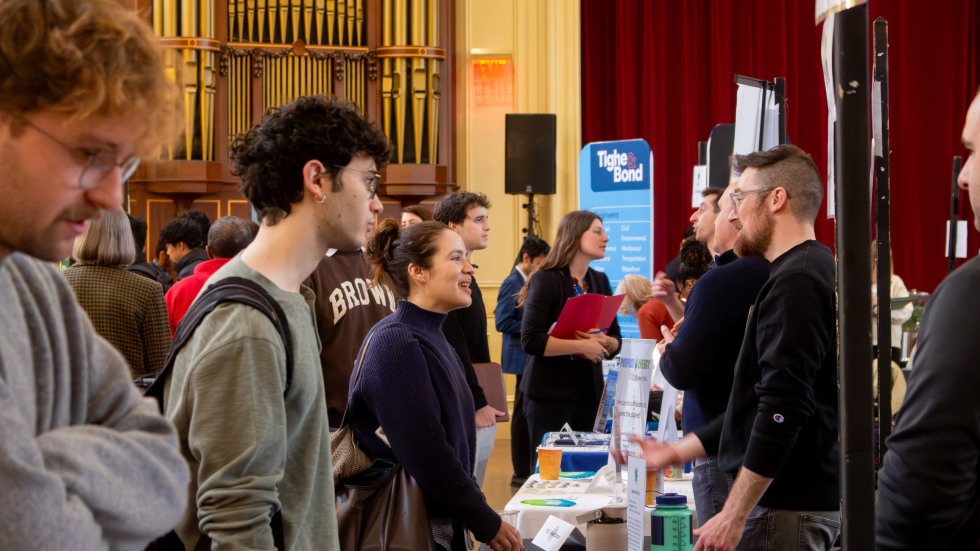
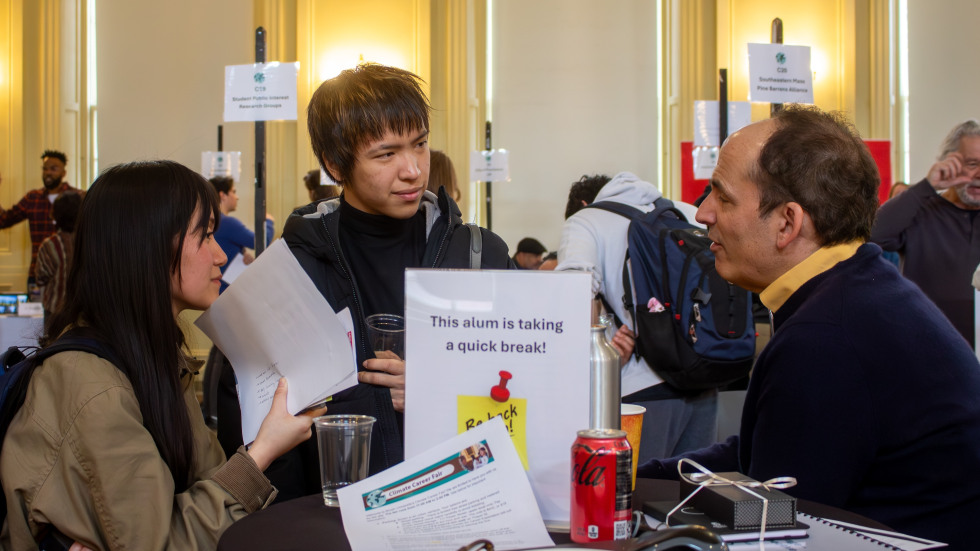
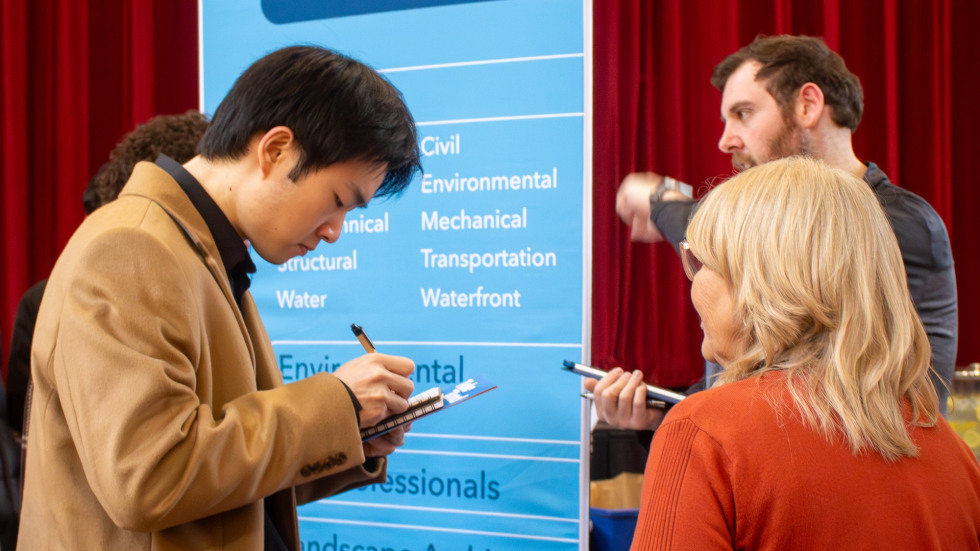
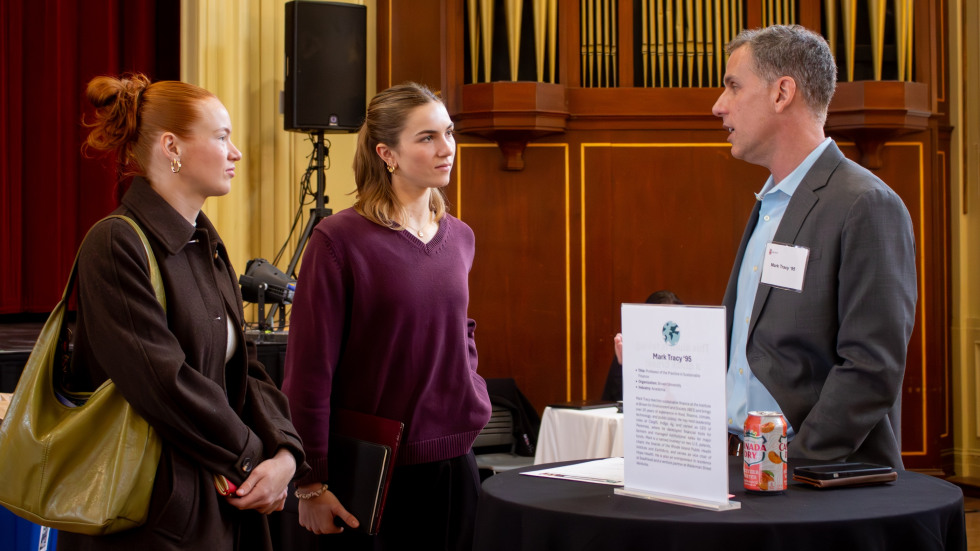
Students connected with employers and alumni at the University-wide Climate Career Fair.
Approximately 200 students attended the second annual Climate Career Fair — co-sponsored by IBES, the Center for Career Exploration, Climate Solutions Lab, Initiative for Sustainable Energy, and School of Public Health — where employers and a strong contingent of Brown alumni gathered to discuss internships, fellowships, and full-time roles across a variety of sectors.
1
of
5
Photo credit: Alloma Fayzullaeva '28
2
of
5
Photo credit: Alloma Fayzullaeva

3
of
5
Photo credit: Dwayne Edwards
4
of
5
Photo credit: Alloma Fayzullaeva
5
of
5
Photo credit: Alloma Fayzullaeva '28
Representatives from organizations spanning consulting, nonprofit advocacy, and public service fielded questions from students about the skills most in demand and the evolving landscape of climate work. Alumni offered candid reflections on navigating early career pivots and building interdisciplinary expertise.
“ To have so much connection, heart, and hope in one room, focused around the climate, was really quite meaningful. ”
Internships, Fellowships, and Research Opportunities for Undergrads
IBES funds a variety of programs for undergraduates, including the Voss Environmental Fellowships, curated summer internships, and extended research assistantships.
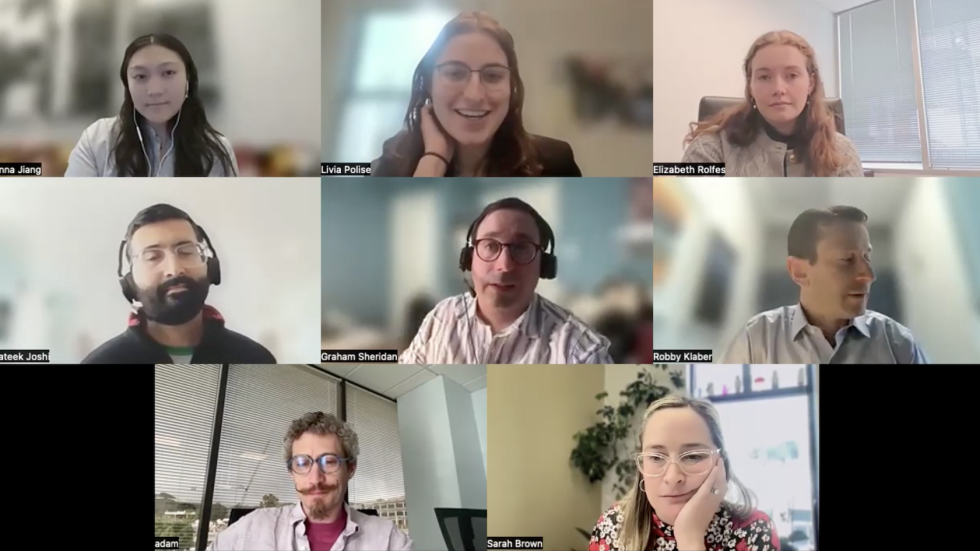
Alumni shared career insights at a virtual climate panel, featuring small-group breakout sessions.
On March 4, alumni working in climate policy, renewable energy, sustainable investing, and environmental justice joined from across the country to reflect on their career arcs in an online alumni panel, organized by IBES and the Center for Career Exploration.
1
of
1
Panelists emphasized adaptability and the ability to communicate across disciplines. They underscored that climate solutions require not only scientists and engineers, but storytellers, economists, lawyers, and community organizers. The discussion reaffirmed the necessity for Brown students to apply their highly unique expertise to climate-related fields.
A Focus on Sustainable Finance
Banking on Nature conference explored how financial systems can accelerate climate solutions.
Saturday’s conference, Banking on Nature: Sustainable Finance and the Environment, convened scholars, practitioners, and students to examine how financial tools are reshaping the pursuit of climate and conservation goals.
Discussions ranged from financial risk and opportunity in nature-based investments to the role of Indigenous knowledge and stewardship in shaping more equitable models of sustainable finance, highlighting both the promise and the complexity of mobilizing capital for environmental protection..
Moderator Ricardo Bayon ’89 and speakers Greg Curtis ’99, Rob Zochowski, Marieke Spence ’01, and
Carl Palmer ’95
Carl Palmer ’95
Moderator Mark Tracy ’95 and speakers Jeannine Cavender-Bares, Jim Kellner, and Joe Mascaro
Moderator Robert Guterl ’26 and speakers Nick Wobbrock, Mohanjeet Brar, and Martin Stuchtey
Student-run FSIcon examined the future of sustainable investing.
The seventh annual Future of Sustainable Investing Conference once again demonstrated the intellectual ambition of Brown’s undergraduates. Organized by students and featuring keynote speakers, panels, and networking sessions, FSIcon connected students with scholars and leaders in sustainable finance.
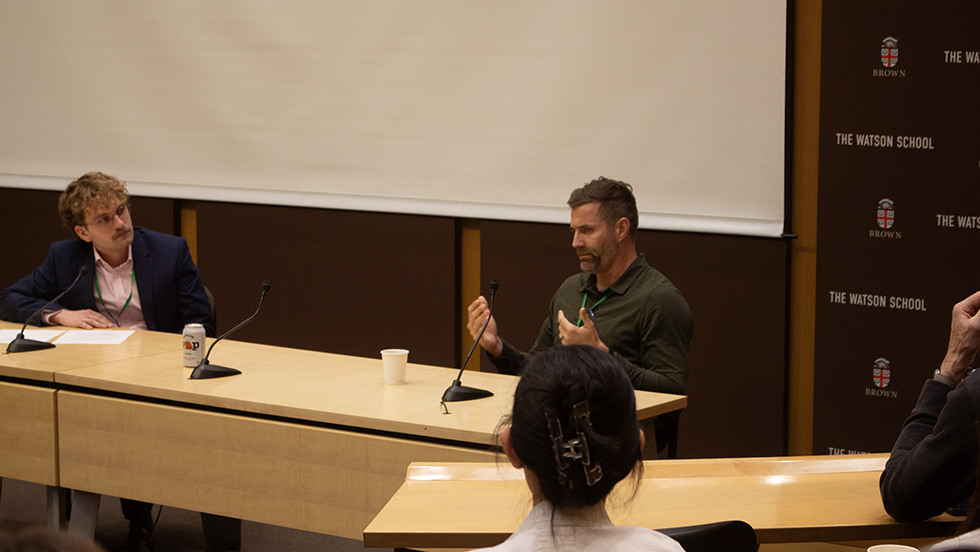
The conference began with a keynote from Greg Curtis, an investment strategist, author, and advocate for sustainability whose work spans asset management, philanthropy, and environmental governance. His address set the stage for a day of discussions on how investors are reconsidering risk, opportunity, and long-term value as climate change and ecological pressures reshape financial decision-making.
1
of
1
Keynote speaker Greg Curtis addresses attendees at the Future of Sustainable Investing Conference, launching a day of student-driven dialogue on the evolving role of sustainability in finance. Photo credit: Alloma Fayzullaeva '28.
Inside Brown’s Climate Work: Progress on Campus and Beyond
A campus conversation examined Brown’s progress toward decarbonization and the work ahead.
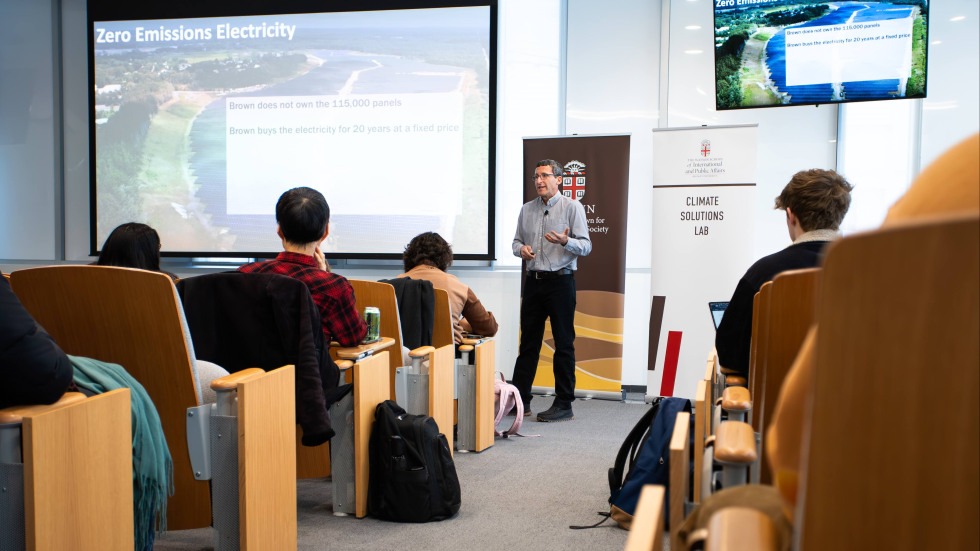
Community members gathered in person and online for a candid assessment of Brown’s path toward net zero emissions. Hosted by the Climate Solutions Lab and IBES, the event featured Professor Stephen Porder as he discussed the University’s decarbonization trajectory.
 Play
Play
1
of
1
Photo credit: Azurae Cruz
Porder outlined the measurable progress Brown has made toward its climate and energy commitments. He detailed ongoing initiatives to reduce campus emissions, improve energy efficiency, and align infrastructure investments with long-term sustainability goals.
Porder also addressed the structural and financial challenges inherent in large-scale decarbonization, emphasizing that institutional transformation requires both technological innovation and sustained community engagement. He concluded by opening the floor for questions, inviting the audience into the conversation.
Education leaders discussed integrating climate into policy, curriculum, and school leadership.
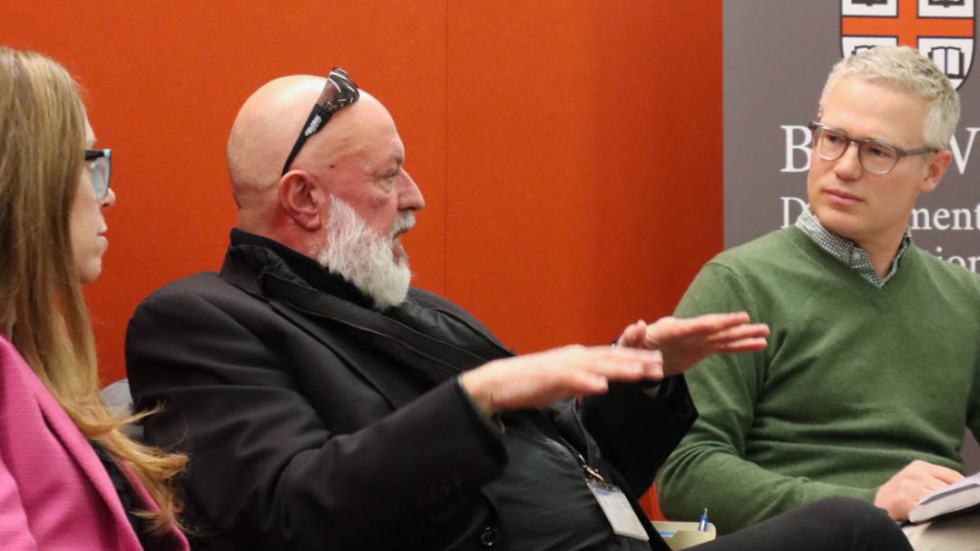
On March 2, the Annenberg Institute, Department of Education, and Sustainable Education Research Initiative convened educators and policy leaders for a panel hosted by SustainableED Founder and Faculty Director Matthew Kraft. The moderated conversation brought together practitioners shaping environmental education across Rhode Island: Joseph da Silva, Director of the HEAL program at the Rhode Island School Building Authority; Jeanine Silversmith, Executive Director of the Rhode Island Environmental Education Association; and Kerry Tuttlebee, Head of School at The Greene School of Rhode Island.
1
of
2
Photo credit: Lucy Kaplan

2
of
2
Photo credit: Lucy Kaplan
Drawing on their experience in public programs, nonprofit advocacy, and school leadership, panelists explored how climate education is evolving beyond classroom instruction to include infrastructure, governance, and institutional culture. Speakers discussed efforts ranging from sustainable school building improvements and green facilities planning to statewide initiatives promoting environmental literacy and outdoor learning opportunities.
Throughout the conversation, panelists emphasized that preparing young people for a climate-altered future calls for schools that model environmental stewardship in their operations, leadership structures, and partnerships with surrounding communities. The discussion underscored the importance of collaboration across educators, policymakers, and local organizations to ensure that climate literacy becomes a durable component of public education.
Providence environmental justice activists connected local campaigns to the global EJAtlas.
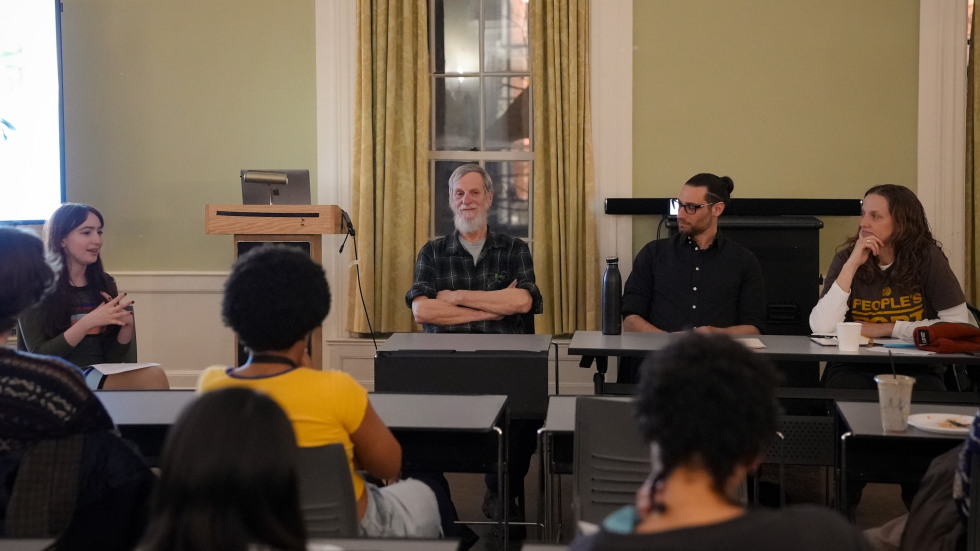
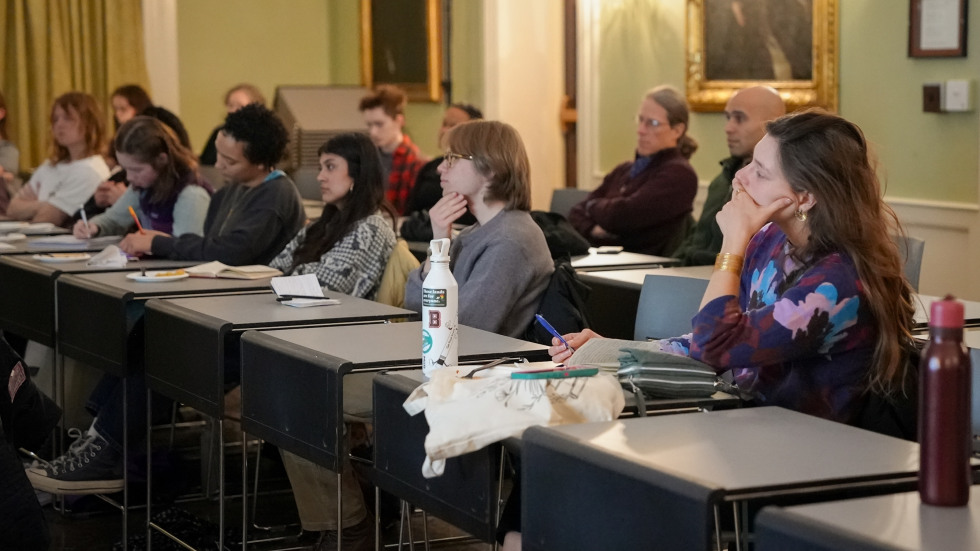
In Alumnae Hall’s Crystal Room, Climate Week turned its attention to the power of grassroots organizing. The event, sponsored by the Global Environmental Justice Working Group, Breathe Providence, IBES, and the Department of Earth, Environmental, and Planetary Sciences, marked the launch of four Rhode Island entries into the Global Atlas of Environmental Justice.
The EJAtlas, an interactive platform coordinated by hundreds of researchers and activists worldwide, documents social conflicts tied to environmental harm. By cataloguing community struggles and victories, the Atlas amplifies local mobilizations and connects them to a global network of resistance and advocacy.
1
of
2
Photo credit: Gracie Vicente
2
of
2
Photo credit: Gracie Vicente
The evening highlighted five Rhode Island cases: Morley Field, Fields Point LNG Liquefaction, the Port of Providence Transfer Station, Alvarez High School, and Rhode Island Recycled Metals. In a conversation moderated by Emma Blankstein ‘26, local activists Ellen Tuzzolo (People’s Port Authority), Julian Drix (Health in Partnership), and Greg Gerritt (Friends of the Moshassuck) traced the history of each campaign, assessed the current landscape of environmental justice organizing in the state, and articulated visions for a more equitable environmental future.
Public health scholars explored links between climate change, health, and vulnerability.

1
of
1
Photo credit: Ken Zirkel
Faculty members from the School of Public Health and IBES explored how climate has a direct and meaningful impact on our health. Following opening remarks from Professor Joseph Braun, Professors Allan Just, Rachel Baker, Corwin Zigler, and Meredith Niles delved into questions of how we will adapt to frequent weather events, and how our responses to climate change can advance our health goals. By situating climate change within a public health framework, the discussion reframed environmental disruption as an immediate human concern.
A film screening invited the Brown community to reflect on climate storytelling through a critical lens.

1
of
1
Photo credit: Peter Chenot
Conversations about climate unfold not only through policy and research, but also through culture and shared experience. Climate Week embraced creative expression through the Brown Arts Institute’s Rigorously Curated film series. Students and community members gathered for a screening of the 2004 disaster film The Day After Tomorrow, introduced with opening remarks from Vice President for Diversity and Inclusion Matthew Guterl, BAI Director Sydney Skybetter, and IBES Faculty Affiliate Baylor Fox-Kemper. Speakers encouraged the audience to approach the film as an opportunity to interrogate how climate narratives are constructed and communicated.
Climate Week cosponsors:
.png)
More IBES Events
Join online or in-person gatherings and be inspired by the remarkable achievements of the IBES community.