Researchers found differences in how respiratory syncytial virus spreads among children in rural versus urban communities and concluded that year-round immunizations would minimize risks of large seasonal outbreaks.
Read Article
Institute at Brown for Environment and Society
Research without boundaries
From tracking wildlife in Yellowstone to studying solar justice worldwide, IBES researchers are breaking boundaries across a range of disciplines.
Research without boundaries
From tracking wildlife in Yellowstone to studying solar justice worldwide, IBES researchers are breaking boundaries across a range of disciplines.
IBES produces research that bridges disciplines and inspires action
Here's a sampling of recent research coverage:
Core faculty research highlights
In Tyler Kartzinel’s Genomic Opportunities Lab, students and scientists work hand-in-hand with global partners to solve urgent conservation challenges, from restoring habitats to understanding what keeps wildlife healthy.
Read Article
News from IBES
Brown Climate Study Named Finalist for PNAS Cozzarelli Prize
Professor Dov Sax and fellow researchers received recognition for their IBES-supported study challenging traditional forecasting methods for the impacts of climate change on species.
Read Article
Affiliate faculty research highlights
IBES Fellow Baylor Fox-Kemper is the leading Brown faculty member involved in SIMCoast, an NSF initiative to track how microplastics move from land to sea and explore what this means for ecosystems, climate, and communities.
Read Article
A new study reveals how woodpeckers combine breathing and whole-body coordination to drill into trees with extraordinary force.
Read Article
The Sustainable Education Research Initiative will build collaborations between scholars, policymakers and practitioners to generate insights that inform Pre-K-12 education policy and practice.
Read Article
A research trip to a biodiversity hotspot in the Gulf of Maine underscores the importance of continued monitoring of marine ecosystems.
Read Article
Researchers showed that hydrogen sulfide, which is associated with numerous health conditions, is emitted from California’s largest lake at levels far higher and more frequently than previously reported.
Read Article
Published Works
IBES faculty produced dozens of peer-reviewed papers this year, advancing research in climate modeling, biodiversity conservation, environmental governance, and sustainability education.
Nature Communications
Model-data synthesis of benthic isotopes suggests a warmer Miocene Climatic Optimum
IBES affiliate Timothy Herbert, a professor in the Department of Earth, Environmental, and Planetary Sciences, contributed to this research.
Read Article
Nature Scientific Reports
African elephants putatively self-medicate with medicinal plants in the Mount Elgon region, Kenya
Voss Postdoc Elodie Freymann is among the lead researchers on a study that found African elephants use dozens of different medicinal plants to treat themselves and their families when they are sick.
Read Article
Climate and Development Lab
Climate Superfund Bills in the U.S. States: A systematic study of opposition
This report — led by IBES researchers including Professor Timmons Roberts, Trevor Culhane, and August DeVore — shows how fossil fuel and energy-intensive industries work to block “Climate Superfund” bills across state legislatures.
Read Article
Palaeogeography, Palaeoclimatology, Palaeoecology
Non-analog ostracod assemblages in Lake Mojave reflect lake Quaternary climate and water-level changes
IBES and DEEPS Assistant Professor Daniel Ibarra is among the authors of this study.
Read Article
IBES affiliate and Catalyst Research Awardee Matthew Kraft, a professor in the Department of Education, and his SustainableED team authored this study, finding that 44% of pre-K-12 schools in the U.S. are within a mile of a known environmental hazard site.
Read Article
Nature Scientific Data
The NASA ABoVE Land, Vegetation, and Ice Sensor full waveform LiDAR airborne surveys
Professor Laurence C. Smith is among the authors of this data descriptor publication.
Read Article
IBES core faculty member serves as lead editor of new open-access volume on climate obstruction
Edited by J. Timmons Roberts, Carlos R. S. Milani, Jennifer Jacquet, and Christian Downie, “Climate Obstruction: A Global Assessment” mobilizes nearly 100 scholars to document how organized interests—from fossil fuels and utilities to agribusiness and PR—impede climate policy. The book also analyzes the rise of regulation, litigation, and civil society movements worldwide to counter obstruction, offering pathways for more effective action.
IBES supports bold projects with meaningful community impact
IBES continues to lead transformative, solutions-focused climate research through major new initiatives, cross-disciplinary programs, and community-engaged projects.
News from IBES
IBES announces 2025 Catalyst Research Awardees
IBES awarded grants to six core and affiliate faculty members, allowing them to conduct research that crosses boundaries and benefits communities, both at Brown and around the world.
News from IBES
Research, Training, Travel: How IBES supports graduate scholars
For the past decade, IBES’ Research, Training, and Travel (RTT) Awards have empowered graduate students working in units across Brown University to advance environmental research while building skills beyond campus.
IBES expands Brown’s capacity for pursuing equitable climate research
IBES serves as the lead partner for Brown's Equitable Climate Futures (ECF) Initiative.
Equitable Climate Futures launched first four working groups
Through its four new working groups, Equitable Climate Futures (ECF) is bringing researchers, policymakers, and community leaders together to co-create just and practical responses to climate change in Rhode Island.
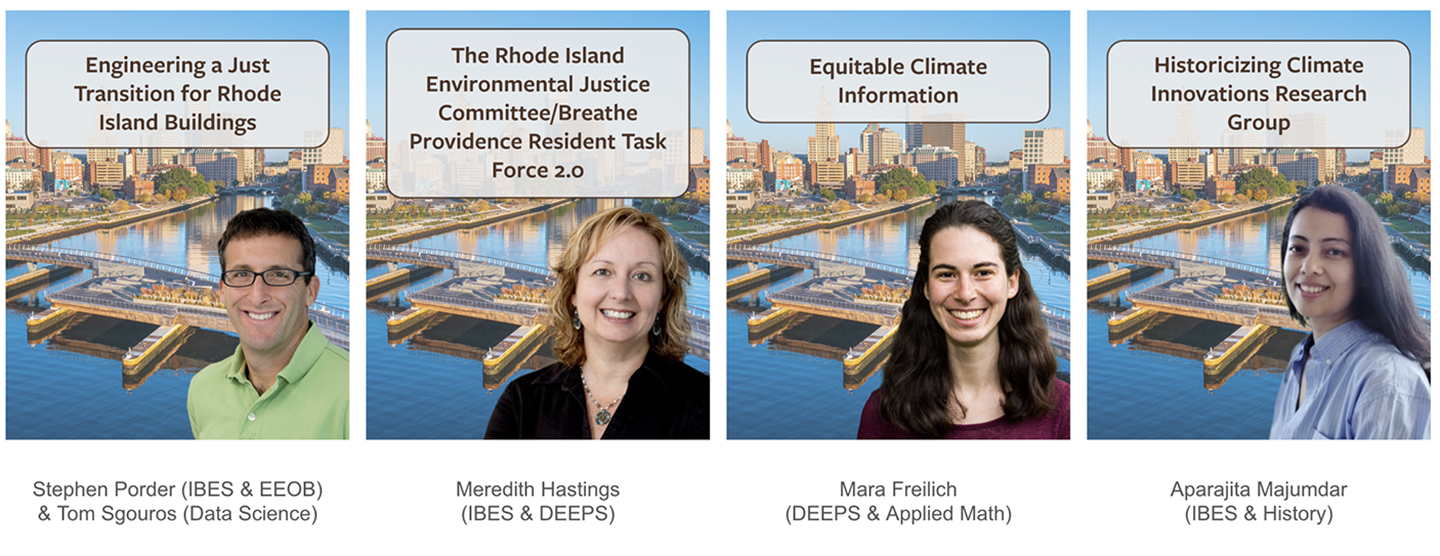
ECF also held its first conference, entitled “Seeding Collaborative Action,” on December 3. Scholars, researchers, students, and community partners gathered for a day of shared inquiry and networking, exploring how interdisciplinary and transdisciplinary research can drive meaningful, equitable climate solutions.
3CRS: Researchers collaborate with waterfront communities to build climate resilience
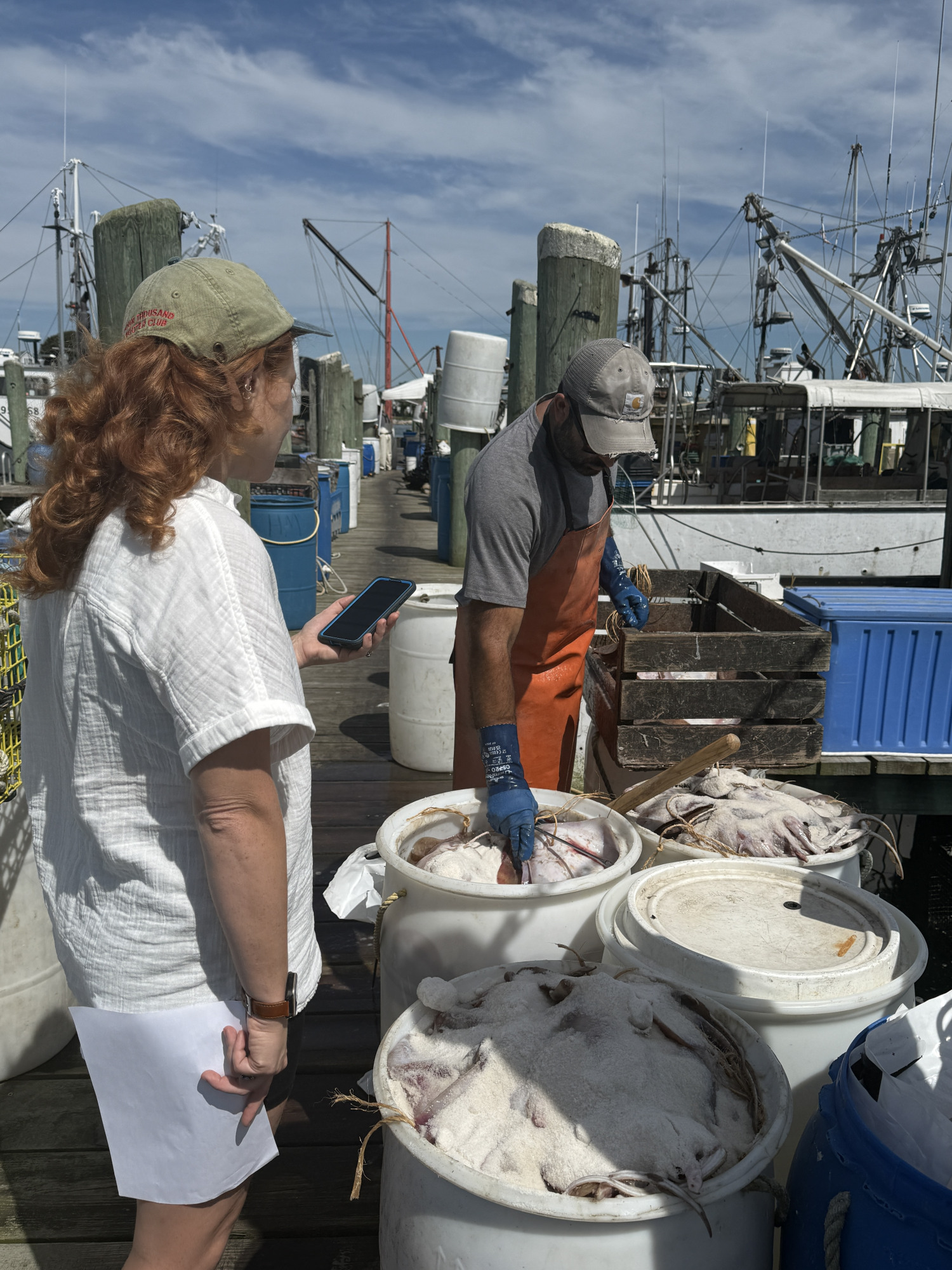
Through the multi-institutional New England Community-Driven Coastal Climate Research and Solutions Hub (3CRS) based at Brown, IBES researchers and partners support working waterfront communities in Rhode Island and Maine in understanding and responding to hyper-local coastal climate hazards.
In 2025, intercept interviews in with coastal residents and fishermen surfaced day-to-day experiences, values, and “sense of place” insights to inform place-based coastal management that aligns with local priorities.
IBES faculty provide mentorships in the Voss program
IBES’ Voss Fellowship programs for postdocs and undergraduates continue to fund independent, faculty-mentored research across disciplines. Voss Undergraduate Fellows pursue yearlong projects that build skills in communication, leadership, and collaboration, while Voss Postdoctoral Fellows bring fresh perspectives and advanced expertise that strengthen IBES’ interdisciplinary research community.
Johnson’s research could guide the development of sustainable plastics—and a more sustainable future.
Read Article
Stevens spent the summer in Colorado studying land stewardship and ecosystem change in the Upper Rio Grande Basin through community interviews and vegetation mapping.
Read Article
A dual-degree student in Environmental Sciences and Studies and the Rhode Island School of Design’s Illustration Department, Ho studies the gut microbiomes of wild sloths in Costa Rica to map normal variation and test how species, habitat, and rehabilitation status shape these microbial communities.
Read Article
Dual concentrator Liza Marcus ’26 is unraveling the complex chemistry of nitrogen oxides and ozone in the atmosphere — work that could improve air quality predictions and inform environmental policy.
Read Article
Kassalow, an Environmental Sciences & Studies concentrator on the conservation science and natural systems track, analyzes samples of parasitic worms found in tropical mammals to expand a scientific database for use by researchers.
Read Article
Gatesi, an Engineering Physics and ENVS concentrator, is researching “the most promising alternative” to standard lithium ion batteries by manipulating Lithium Lanthanum Zirconium Tantalum Oxide (LLZTO) to be more sustainable.
Read Article